
When to Buy a Home Based on Mortgage Rates
Definition
mortgage is a loan used to purchase or maintain real estate, where the property serves as collateral
Key Takeaways
- Mortgages are loans used to buy homes and other types of real estate. The property itself serves as collateral for the loan.
- Mortgages are available in a variety of types, including fixed- and adjustable-rate.
- The cost of a mortgage will depend on the type of loan, the term (e.g., 30 years), and the interest rate that the lender charges.
- Mortgage rates can vary widely depending on the type of product and the applicant’s qualifications.
What Is a Mortgage?
A mortgage is a loan used to purchase or maintain a home, plot of land, or other real estate. The borrower agrees to pay the lender over time, typically in a series of regular payments divided into principal and interest. The property then serves as collateral to secure the loan.
A borrower must apply for a mortgage through their preferred lender and meet several requirements, including minimum credit scores and down payments. Mortgage applications undergo a rigorous underwriting process before they reach the closing phase.
How Mortgages Work
Individuals and businesses use mortgages to buy real estate without paying the entire purchase price up front. The borrower repays the loan plus interest over a specified number of years until they own the property free and clear. Most traditional mortgages are fully amortized. This means that the regular payment amount will stay the same, but different proportions of principal vs. interest will be paid over the life of the loan with each payment. Typical mortgages last for 15 or 30 years, but some mortgage terms can be longer.1
Mortgages are also known as liens against property or claims on property. If the borrower stops paying the mortgage, the lender can foreclose on the property.
For example, a residential homebuyer pledges their house to their lender, which then has a claim on the property. This ensures the lender’s interest in the property should the buyer default on their financial obligation. In the case of foreclosure, the lender may evict the residents, sell the property, and use the money from the sale to pay off the mortgage debt.
The Mortgage Process
Would-be borrowers begin the process by applying to one or more mortgage lenders. The lender will ask for evidence that the borrower can repay the loan. This may include bank and investment statements, recent tax returns, and proof of current employment. The lender will usually run a credit check as well.
If the application is approved, the lender will offer the borrower a loan up to a certain amount and at a particular interest rate. Thanks to a process known as pre-approval, homebuyers can apply for a mortgage after they’ve chosen a property to buy or even while they’re still shopping for one. Being pre-approved for a mortgage can give buyers an edge in a tight housing market because sellers will know that they have the money to back up their offer.
Once a buyer and seller agree on the terms of their deal, they or their representatives will meet at what’s called a closing. This is when the borrower makes their down payment to the lender. The seller will transfer ownership of the property to the buyer and receive the agreed-upon sum of money, and the buyer will sign any remaining mortgage documents. The lender may charge fees for originating the loan (sometimes in the form of points) at the closing.
Options
There are hundreds of options for where you can get a mortgage. You can secure one through a credit union, bank, mortgage-specific lender, online-only lender, or mortgage broker. No matter which option you choose, compare rates across types to make sure that you’re getting the best deal.
Types of Mortgages
There are many types of mortgages. The most common ones are 30- and 15-year fixed-rate mortgages. Some terms are as short as five years, while others can run 40 years or longer. Extending your loan can lower your monthly payment, but it increases the total amount of interest you’ll pay over time.1
Other types of home loans, such as Federal Housing Administration (FHA) loans, United States Department of Agriculture (USDA) loans, and U.S. Department of Veterans Affairs (VA) loans, are only available for specific populations that may not have the income, credit scores, or down payments required to qualify for conventional mortgages.
The following are just a few examples of some of the most popular types of mortgages available to borrowers.
Fixed-Rate Mortgages
With a fixed-rate or traditional mortgage, the interest rate and the monthly payment remain the same during the entire loan term.1
Warning
Mortgage lending discrimination is illegal. If you think you’ve been discriminated against based on race, religion, sex, marital status, use of public assistance, national origin, disability, or age, there are steps that you can take. One such step is to file a report with the Consumer Financial Protection Bureau (CFPB) or the U.S. Department of Housing and Urban Development (HUD).
Adjustable-Rate Mortgage (ARM)
With an adjustable-rate mortgage (ARM), the interest rate is fixed for an initial term, after which it can change periodically based on prevailing interest rates. The initial interest rate is often below market, which can make the mortgage more affordable in the short term but possibly less affordable in the long run if the rate rises substantially.
ARMs typically have limits, or caps, on how much the interest rate can rise each time it adjusts and in total over the life of the loan.
Tip
A 5/1 adjustable-rate mortgage is an ARM that maintains a fixed interest rate for the first five years and then adjusts each year after that.
Interest-Only Loans
Other, less common types of mortgages, such as interest-only mortgages and payment-option ARMs, can involve complex repayment schedules and are best used by sophisticated borrowers. These loans may feature a large balloon payment at the end.
Many homeowners got into financial trouble with these types of mortgages during the housing bubble of the early 2000s.
Reverse Mortgages
Reverse mortgages are designed for homeowners 62 or older who want to convert part of the equity in their homes into cash. With a reverse mortgage, homeowners can borrow against the value of their home and receive the money as a lump sum, fixed monthly payment, or line of credit (LOC).3 The entire loan balance becomes due when the borrower dies, moves away permanently, or sells the home.4
Tip
Within each type of mortgage, borrowers can buy discount points to lower their interest rate. Points are essentially a fee that borrowers pay upfront to lower the interest rate over the life of their loan. When comparing mortgage rates, compare rates with the same number of discount points for a true apples-to-apples comparison.5
Average Mortgage Rates (So Far for 2025)
How much you’ll have to pay for a mortgage depends on the type (e.g., fixed or adjustable), its term (e.g., 20 or 30 years), any discount points paid, and the interest rates at the time. Interest rates can vary from week to week and from lender to lender, so it pays to shop around.
Mortgage rates sank to historic lows in 2020 and 2021, recording their cheapest levels in almost 50 years. From roughly the start of the pandemic in April 2020 to January 2022, the 30-year fixed-rate average hovered below 3.50%—including an ultimate low of 2.65%.6
But 2022 and 2023 saw mortgage rates skyrocket, setting records in the opposite direction. The 30-year fixed-rate average breached the 7% threshold for the first time in 20 years in October 2022. Since then, the 30-year mortgage rate has fluctuated within the 6% to 8% range.6
According to Freddie Mac, as of November 2025, the average interest rates are:
What is alternative financing?
Typical alternative financing arrangements, such as land contracts, seller-financed mortgages, lease-purchase agreements, and personal property loans, differ from mortgages in important ways. For the purposes of this analysis, a mortgage is a real estate purchase credit agreement that typically involves a third-party lender who has no prior or other interest in the property separate from the loan and must comply with federal and state regulations. In mortgage transactions, title—that is, full legal ownership of the property as documented in a deed—transfers from seller to buyer at the same time the loan is initiated. By contrast, certain common alternative arrangements, for example land contracts, are not subject to significant regulations, and in purchases using these types of financing, the seller—and not the buyer as in a mortgage transaction—keeps the deed to the property for the duration of the financing term. And because many jurisdictions do not consider buyers to be homeowners if they do not officially hold title and have the deed in hand, this structure can create legal ambiguity and make it difficult for buyers to establish clear ownership or know with certainty who is responsible for property taxes and maintenance.
Although the rights and protections afforded to mortgage borrowers can provide useful comparisons for understanding the risks that accompany alternative financing, not all financially qualified borrowers can get a mortgage, because of the shortage of small mortgages and because some kinds of properties are not mortgage-eligible. For example, some homes may not meet required habitability standards, such as having certain utility connections or a fully finished kitchen or bathroom, and manufactured homes are often titled as personal property, which is movable property such as a car or a refrigerator, rather than real property, also called real estate, which includes land and any permanent structure on it.5 The most common alternative arrangements are:
- Land contracts. In these arrangements, also called “contracts for deed” or “installment sales contracts,” the seller extends credit directly to the buyer, who then pays regular installments on the debt often for an agreed-upon time period, without the involvement of a third-party lender. Some buyers refer to their contract payments as “rent,” though—as with a mortgage—at least some portion of the payment goes toward the purchase price for the home as dictated by the contract terms. Unlike a mortgage, however, the deed does not transfer to the buyer at the outset in most states; instead, the seller retains full legal ownership of the property until the final payment is made, leaving the buyer without clear rights to either the home or the equity that has accrued.6 Among alternative financing arrangements, land contracts have received the most attention from academics and legislators.
- Lease-purchase agreements. Under these arrangements, commonly referred to as “rent-to-own” or “lease with option to purchase,” the seller is also the landlord, and the buyer occupies the property as a tenant and typically pays an upfront fee or down payment in exchange for the option to purchase the home within a designated period. If the buyer exercises that option, a portion of the buyer’s previous monthly payments, which often exceed market rent for a comparable property, may also be applied toward the down payment for purchase. Then, either the seller or a financial institution extends credit to the buyer for the balance to be repaid over time, and usually the deed transfers at the time the loan is originated. However, if the buyer is unable or unwilling to finalize the transaction, the terms of the lease-purchase agreement may allow the seller to keep some or all of the buyer’s payments.
Buyers and landlords often describe lease-purchase agreements as a way for tenants to improve their credit scores, build a credit history, and save for a down payment, but little is known about how many lease-purchase buyers ultimately achieve homeownership, continue renting, or withdraw from the deal without exercising their option to buy. - Personal property loans. These financing products, also known as “home only” or “chattel” loans, are used to buy manufactured homes and are frequently issued by subsidiary lenders of manufactured home builders, although some banks, credit unions, and other lenders also offer this type of financing. Personal property loans typically have much higher interest rates and shorter terms than comparably sized mortgages, resulting in more expensive monthly payments and more interest paid over the life of the loan.7 In addition, personal property loan borrowers have fewer protections in default: In many states, lenders can quickly repossess homes bought with personal property loans, because they are not subject to the foreclosure process required for mortgages.8
When borrowers purchase manufactured housing with these loans, they are buying their homes as personal rather than real property, and only the structures—not the land beneath—are included in the titles and paid for with the loans. By contrast, in real property transactions, the home and land are titled together and can be financed jointly with a mortgage. Although 73% of personal property loan borrowers rent the land under their homes and face associated risks—unique among homeowners—such as sharp land rent increases and the possibility of being evicted, the remaining 27% own their land and could be eligible for mortgages, assuming they meet underwriting requirements. 9 However, to get a mortgage, these landowners would first need to have the home and land retitled together as real rather than personal property. And depending on state laws, such title changes can be difficult or impossible to accomplish, leaving some landowning homebuyers no choice but to finance their manufactured home purchase with a personal property loan.10 - Seller-financed mortgages. In these arrangements, the seller also acts as the lender, directly extending credit to the buyer to purchase the home, with no third-party lender involved. The deed to the home transfers to the buyer at the start of the agreement—just as with a traditional mortgage—giving the buyer full ownership rights while the loan is repaid over time. But almost no states have enacted laws for seller-financed mortgages, and federal rules apply only to sellers who finance more than three properties per 12-month period.11 These limited protections generally leave buyers without clear recourse if the seller has not taken steps to ensure that the home is habitable, the contract terms are fair, and the title has no competing claims.
All of these arrangements fall under the rubric of alternative financing, but the required contractual provisions and applicable consumer protections for each vary widely from state to state. In general, research has shown that alternative arrangements are associated with higher long-term costs, less favorable contract terms, and an increased risk of losing home equity compared with commensurate mortgages.
How to Compare Mortgages
In the past, banks, savings and loan associations, and credit unions were practically the only sources of mortgages. Today, however, a burgeoning share of the mortgage market includes nonbank lenders like Better, loanDepot, Rocket Mortgage, and SoFi.
If you’re shopping for a mortgage, an online mortgage calculator can help you compare estimated monthly payments based on the type of mortgage, the interest rate, and how large a down payment you plan to make. It can also help you determine how expensive a property you can reasonably afford.
In addition to the principal and interest you’ll be paying on the mortgage, the lender or mortgage servicer may set up an escrow account to pay local property taxes, homeowners’ insurance premiums, and other expenses. Those costs will add to your monthly mortgage payment.
If you make less than a 20% down payment when you take out your mortgage, your lender may require that you purchase private mortgage insurance (PMI), which becomes another monthly cost.8
Calculate Your Monthly Payment
Your monthly mortgage payment will depend on your home price, down payment, loan term, property taxes, homeowners insurance, and interest rate on the loan (which is highly dependent on your credit score). Use the inputs below to get a sense of what your monthly mortgage payment could end up being.Enter Home Price
Important
If you have a mortgage, you still own your home. Your bank may have loaned you money to purchase the house, but rather than owning the property, they imposed a lien on it. If you default and foreclose on your mortgage, however, the bank may become the new owner of your home.
Explain Like I’m 5
A secured loan is an option for borrowing money that’s backed by a valuable asset. If a borrower is unable to repay their debt, then their lender can seize the asset to recoup its loss. A mortgage is a type of secured debt that’s used to purchase a home or other kind of real estate, which acts as the collateral. As such, if a borrower defaults on a mortgage, the lender can take possession of the property.
Due to the price of a typical house, few people can afford to pay for one out of pocket. A mortgage allows a borrower to purchase a home by making only a relatively small down payment, such as 20% of the purchase price, while taking out a loan to cover the remaining costs. Once you’ve been approved for a mortgage, you’ll begin making monthly payments in order to eventually repay that debt.
In addition to repaying the amount borrowed, interest is also regularly levied on the outstanding balance. The longer the loan term, the more chances for interest to accrue. As such, a longer loan term means paying more in interest over the life of the mortgage. Additional loan costs can also include insurance and fees.
Can Anybody Get a Mortgage?
Mortgage lenders must approve prospective borrowers through an application and underwriting process. Home loans are only provided to those with sufficient assets and income relative to their debts. Lenders look at an applicant’s credit score before approving a mortgage. The interest rate also varies, with riskier borrowers receiving higher interest rates.9
Mortgages are offered by a variety of sources. Banks and credit unions often provide home loans, in addition to specialized mortgage companies that deal only with home loans. You may also employ an unaffiliated mortgage broker to help you shop around for the best rate among different lenders.
How Many Mortgages Can I Have on My Home?
Lenders generally issue a first or primary mortgage before allowing a second one. This additional mortgage is commonly known as a home equity loan. There’s technically no limit to how many junior mortgages you can have on your home as long as you have the equity, debt-to-income (DTI) ratio, and credit score to get approved for them.
Why Is It Called a Mortgage?
The word “mortgage” comes from Old English and French, meaning “death vow.” It gets that name since this type of loan “dies” when it is either fully repaid or if the borrower defaults.10
The Bottom Line
Mortgages are an essential part of home buying for most borrowers, who aren’t sitting on hundreds of thousands of dollars of cash to buy a property outright. Different types of home loans are available for whatever your circumstances may be. Different government-backed programs allow more people to qualify for mortgages and make their dream of homeownership a reality, but comparing the best mortgage rates will make the homebuying process more affordable.
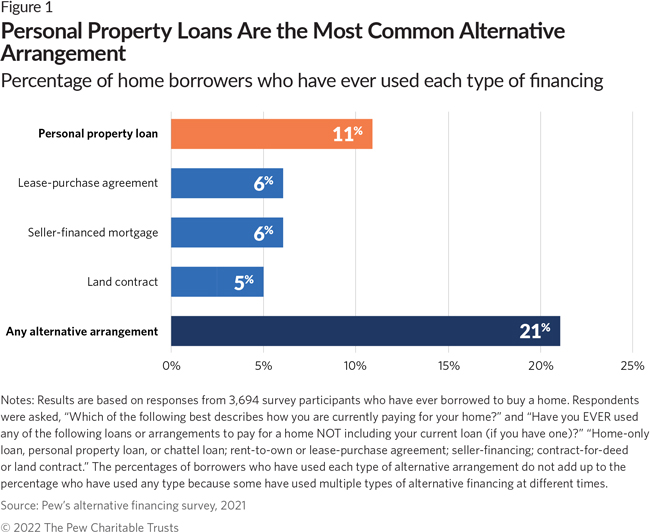
Personal property loans are the most common type of alternative arrangement; about 11% of home borrowers have used them to buy a home.14 Much more is known about these loans than other alternative arrangements, because the Home Mortgage Disclosure Act requires lenders who make personal property loans to report details for each loan application to the Consumer Financial Protection Bureau (CFPB). That data shows that, compared with manufactured home buyers who obtain mortgages, personal property loan borrowers have similar financial characteristics but pay much higher interest rates.15 For example, over the life of a $100,000 home loan, a personal property loan borrower would pay a 7.75% interest rate, twice that of a mortgage borrower’s 3.75% and costing almost $48,000 more.16
After personal property loans, the survey found that other common types of alternative financing are lease-purchase agreements (6%), seller-financed mortgages (6%), and land contracts (5%). Most research into the prevalence, terms, and outcomes of these alternative arrangements has focused on land contracts, because some state and local governments require public recording of land contract transactions while almost none do for seller-financed mortgages or lease-purchase agreements.17
Additionally, and in part because of a lack of consistent national regulatory or statutory conventions defining these three types of alternative arrangements, such as exists for mortgages, the language used to describe them varies across the U.S., and unscrupulous sellers can use the resulting lack of clarity to their advantage, referring to arrangements by other names to circumvent laws. For example, in states with strong land contract laws but weak renter protections, land contract sellers could skirt the consumer protections by marketing their financing to buyers as rent-to-own arrangements, while still structuring the financing as land contracts.18
Further, the available evidence indicates that lease-purchase agreements, seller-financed mortgages, and land contracts often share risky features that lead buyers to pay higher costs and can result in default and potentially loss of the home and all funds paid. For example, sellers may inflate their asking prices for a property because third-party appraisals are not required; they may insist that buyers pay for repairs to properties for which the buyers do not hold clear title; or they may evict buyers without first offering buyers the opportunity to catch up on missed payments.19 Because seller-financed mortgages and lease-purchase agreements are about as common as the better-studied land contracts and can lead to similarly harmful outcomes, they merit more research attention.
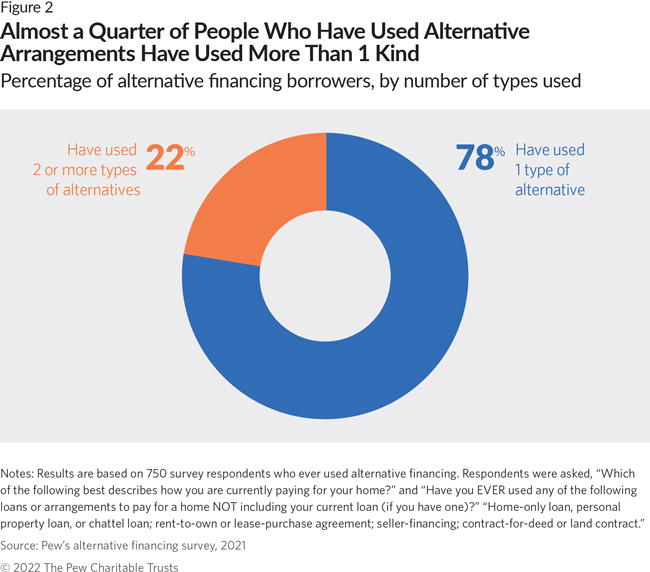
Among borrowers who have used alternative financing, 22% have used more than one of the arrangements that Pew studied. (See Figure 2.) And although the available evidence is insufficient to explain why borrowers use these alternatives, it does indicate that even financially capable borrowers face systemic barriers to accessing mortgages.
The increased costs and risks associated with alternative financing raise concerns about their recurring use by the same households. For example, legal aid advocates and researchers have called attention to profit-driven “churning,” which occurs when an owner initiates the sale of the same house repeatedly, receiving deposits or other unsecured payments from successive buyers under alternative agreements that, because of the lack of regulatory controls on such arrangements, never result in any of the buyers achieving full ownership or recouping their investments.20 However, little is known about how often this occurs and at what point these agreements typically collapse, so more research is warranted.
Use of alternative financing varies by race and ethnicity
Among home borrowers, the likelihood of using alternative arrangements varies by race and ethnicity. Hispanic households that have financed a home purchase are more likely to have used alternative financing compared with other households: 34% of Hispanic borrowers reported using at least one alternative arrangement compared with 23% of non-Hispanic Black borrowers and 19% of non-Hispanic White borrowers. (See Figure 3.)
Other research aligns with these findings and offers additional insights. For example, CFPB found that, among buyers of manufactured homes, Hispanic, Black, and Indigenous families were more likely than other households to use personal property loans.21 Further, an analysis from the Federal Reserve Bank of Minneapolis found that Indigenous people living on reservation trust lands were more likely than their neighbors who do not live on trust land to apply for personal property loans to purchase manufactured homes—at least in part because of obstacles to using trust land as collateral for a mortgage.22 And the Federal Reserve Bank of Atlanta found that, from 2001 to 2009, Hispanic and Black households were more likely than other households to use land contracts to purchase a home.23
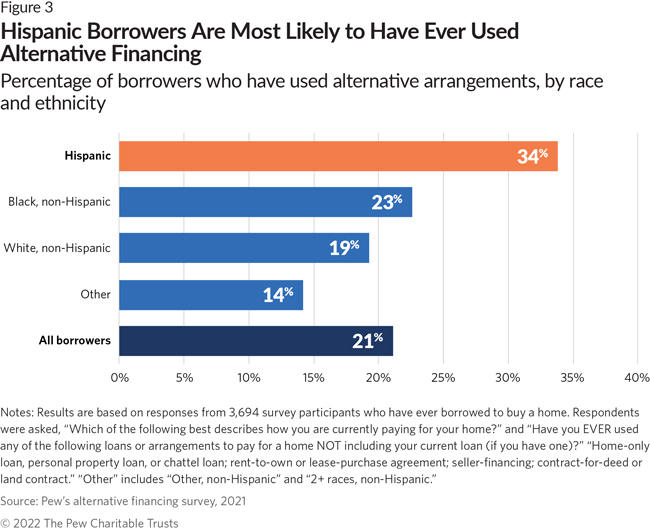
These disparities in the use of alternative financing may reflect racial and ethnic inequalities in mortgage approval rates and loan costs: Historically, Hispanic and Black borrowers have been more likely to have mortgage applications denied and to receive high-cost mortgages if their applications are approved.24
Approximately 7 million adults currently use alternative financing
Among the roughly 114 million adults who have debt on their home, Pew’s survey found that about 7 million, or 1 in 15 current home borrowers, currently use one of these arrangements.25
Use of alternative financing is higher among borrowers with lower incomes
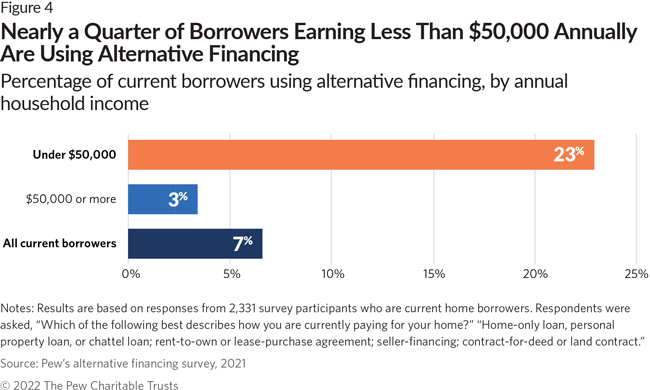
The survey found that lower-income borrowers are more likely than those with higher incomes to use alternative arrangements, making financially vulnerable families less likely to benefit from the consumer protections granted to federally regulated mortgages. Among all current borrowers, those with annual household incomes under $50,000 were more than seven times as likely to be using alternative financing instead of mortgages to buy their homes compared with individuals with annual household incomes above $50,000. (See Figure 4.)
Some low-income households may use alternative arrangements because they cannot qualify for mortgages under current underwriting standards. For instance, low-income families are more likely than higher-income households to have volatile incomes and little or no credit history, both of which are barriers to being approved for a mortgage.26 Further, underwriting practices have not historically recognized borrowers’ demonstrated ability to make regular monthly rent payments as evidence that they could manage comparable mortgage obligations, although Fannie Mae did launch an underwriting program in September 2021 to expand mortgage eligibility to households with rental payment histories, which should help address this gap.27
However, several other factors, including habitability standards for low-cost homes, manufactured home titling issues, and the shortage of small mortgages, also may drive borrowers into alternative financing, and some may not seek mortgages at all. More research is needed to understand how borrowers enter alternative arrangements and what roles mortgage eligibility and access play.
Understanding alternative financing can help policymakers better protect, support consumers
Research suggests that the harms associated with some alternative financing arrangements persist largely because of the lack of consumer protections, particularly contract recording requirements, or the insufficient enforcement of such protections where they do exist.28 Recording an alternative financing contract with a local government clerk or records office provides documentation of agreements made between seller and buyer and of the buyer’s rights to the home.29 Pew-commissioned research from the National Consumer Law Center found that about a dozen states have enacted laws or ordinances mandating public recording of land contracts and that none have done so for seller-financed mortgages.30 But statutory requirements aside, legal aid providers have observed that sellers sometimes choose to record alternative financing arrangements to protect their ownership interest if a borrower defaults.31
However, when alternative financing arrangements are not recorded, the resulting lack of documentation can prevent lawyers, housing advocates, government officials, and other stakeholders from determining who holds legal ownership of a property. This, in turn, can obscure the assignment of responsibilities, such as paying taxes or ensuring habitability, as well as the distribution of rights and benefits, including eligibility for homeowner tax exemptions, natural disaster relief, or insurance claim payouts.
Without public recording, lawmakers cannot know how many households use alternative financing or appropriately allocate financial aid or other resources when needed. During the COVID-19 pandemic, for instance, federal and state governments have provided financial assistance and eviction protections to homeowners and renters. But the legal ambiguity associated with some alternative arrangements has meant that borrowers were often ineligible for those supports, and given the disparities in alternative financing use, this ineligibility is likely to have compounded hardships for the low-income and minority families who were the most likely to struggle financially during the pandemic.32
Some recent policies have explicitly included alternative financing borrowers alongside mortgage borrowers. For example, the U.S. Department of the Treasury released guidance in August 2021 to clarify that its Homeowner Assistance Fund can provide financial assistance to homeowners with land contracts or personal property loans for manufactured homes, as well as those with mortgages.33 However, the guidance leaves it to state officials to determine the number of borrowers in their states who are eligible to receive the funding. Some states, such as New York and Wisconsin, have taken proactive steps to include land contract and personal property loan borrowers in their Homeowner Assistance Fund distribution plans. But in most states, without recording requirements to document borrowers and policy action to expand eligibility, many of the 7 million people who currently use alternative financing might not receive funds for which they would otherwise qualify should they need assistance. In addition, the Federal Emergency Management Agency in September 2021 provided mechanisms for manufactured home owners, who do not have a deed or similar traditional documentation, to prove ownership.34 These policy changes reflect a growing recognition at the federal and state levels of the need to address the challenges faced by home borrowers who use alternative financing.
Conclusion
This new survey data shows that nationwide, tens of millions of families have used alternative financing arrangements at some point to pursue their goals of homeownership, but also that some borrowers are more likely than others to do so. The findings highlight disparities by race, ethnicity, and income that reflect broader inequalities in the mortgage market.
State and federal policymakers have proposed legislation, regulation, and programmatic guidelines in recent years that have sought to include alternative financing. But scarce information about the prevalence of these arrangements as well as who uses them and why, among other challenges, has limited the reach of those efforts, leaving millions of borrowers at risk. The data presented in this brief can begin to fill that gap and help policymakers craft better strategies to protect all home borrowers.
Endnotes
- The Pew Charitable Trusts, “What Has Research Shown About Alternative Home Financing in the U.S.?” (2022), https://www.pewtrusts.org/en/research-and-analysis/issue-briefs/2022/04/what-has-research-shown-about-alternative-home-financing-in-the-us.
- A. Horowitz and T. Roche, “Small Mortgages Are Hard to Get Even Where Home Prices Are Low,” The Pew Charitable Trusts, Sep. 11, 2020, https://www.pewtrusts.org/en/research-and-analysis/articles/2020/09/11/small-mortgages-are-hard-to-get-even-where-home-prices-are-low; B. Eisen, “Small Mortgages Are Getting Harder to Come By,” The Wall Street Journal, May 9, 2019, https://www.wsj.com/articles/small-mortgages-are-getting-harder-to-come-by-11557394201; A. Carpenter, T. George, and L. Nelson, “The American Dream or Just an Illusion? Understanding Land Contract Trends in the Midwest Pre- and Post-Crisis” (Joint Center for Housing Studies of Harvard University, 2019), 3, 13-14, https://www.jchs.harvard.edu/sites/default/files/media/imp/harvard_jchs_housing_tenure_symposium_carpenter_george_nelson.pdf.
- Alanna McCargo et al., “Small-Dollar Mortgages for Single-Family Residential Properties” (Urban Institute, 2018), V-VI, https://www.urban.org/research/publication/small-dollar-mortgages-single-family-residential-properties; Consumer Financial Protection Bureau, “Manufactured Housing Finance: New Insights From the Home Mortgage Disclosure Act Data” (2021), 3-4, 7, https://files.consumerfinance.gov/f/documents/cfpb_manufactured-housing-finance-new-insights-hmda_report_2021-05.pdf. Manufactured houses, unlike their mobile predecessors, are built to robust federal quality standards that may even exceed local standards for site-built homes. Manufactured housing is eligible for mortgage financing when owned as real property—where the home and land are titled together. However, when manufactured homes are titled as personal property separate from the land beneath, buyers are not eligible for a mortgage.
- Carpenter, George, and Nelson, “The American Dream or Just an Illusion?,” 1; A. Carpenter, A. Lueders, and C. Thayer, “Informal Homeownership Issues: Tracking Contract for Deed Sales in the Southeast” (Community and Economic Development Department, Federal Reserve Bank of Atlanta, 2017), https://www.frbatlanta.org/-/media/documents/community-development/publications/discussion-papers/2017/02-informal-homeownership-issues-tracking-contract-for-deed-sales-in-the-southeast-2017-06-14.pdf.
- Alanna McCargo et al., “Small-Dollar Mortgages for Single-Family Residential Properties,” V-VI; Consumer Financial Protection Bureau, “Manufactured Housing Finance,” 3-4, 7.
- The Pew Charitable Trusts, “What Has Research Shown About Alternative Home Financing in the U.S.?”; National Consumer Law Center, “Summary of State Land Contract Statutes” (2021), 3-4, https://www.pewtrusts.org/en/research-and-analysis/white-papers/2022/02/less-than-half-of-states-have-laws-governing-land-contracts.
- Consumer Financial Protection Bureau, “Manufactured Housing Finance,” 25, 33, 38.
- N. Bourke and R. Siegel, “Protections for Owners of Manufactured Homes Are Uncertain, Especially During Pandemic,” The Pew Charitable Trusts, Sept. 11, 2020, https://www.pewtrusts.org/en/research-and-analysis/articles/2020/09/11/protections-for-owners-of-manufactured-homes-are-uncertain-especially-during-pandemic.
- Consumer Financial Protection Bureau, “Manufactured Housing Finance,” 34.
- Ibid., 33-34, 36-37.
- Consumer Financial Protection Bureau, 12 CFR Part 1026 (Regulation Z) § 1026.36, Prohibited Acts or Practices and Certain Requirements for Credit Secured by a Dwelling, https://www.consumerfinance.gov/rules-policy/regulations/1026/36/; Texas Finance Code, Chapter 180. Residential Mortgage Loan Originators, Texas Secure and Fair Enforcement for Mortgage Licensing Act of 2009 (2009), https://statutes.capitol.texas.gov/Docs/FI/htm/FI.180.htm. Pew commissioned the National Consumer Law Center (NCLC) to analyze state laws, statutes, and major legal decisions governing seller-financed mortgages. The study found that only Delaware and Texas have laws specific to these loans, that Delaware’s law only addresses certain processes required before closing, and that Texas’ does not impose additional conditions on small-scale sellers who are exempt from federal regulation. NCLC did not find any states with seller-financed mortgage laws specifically related to recording requirements, habitability standards, or remedies upon default.
- The Pew Charitable Trusts, “What Has Research Shown About Alternative Home Financing in the U.S.?”
- Pew’s survey found that about 67% of U.S. adults have ever borrowed to buy a home, roughly 14% of U.S. adults have ever used alternative financing, and approximately 62% have ever had a mortgage. The percentages of adults who have ever used mortgages and alternative arrangements do not add up to the percentage who have ever borrowed, because some have used both at different times. Calculations of the numbers of adults are based on the 2019 one-year estimate for Americans 18 years of age and older: 255,271,738. U.S. Census Bureau, American Community Survey, Table S0101-Age and Sex, 2019 one-year estimates.
- Through focus groups with manufactured housing residents and a review of industry terminology, Pew has learned that personal property loans are commonly referred to as “mortgages” even when the land is not included. However, these buyers know whether their home loan includes the land beneath the home, as Pew researchers confirmed by looking at focus group participants’ loan documentation. Where respondents said they had a current mortgage that covered only their manufactured home and not the land beneath it (32 of 78 manufactured housing residents who reported a current mortgage), these loans have been classified as current personal property loans and counted as current alternative financing.
- Consumer Financial Protection Bureau, “Manufactured Housing Finance,” 11-12, 25, 33.
- Federal Financial Institutions Examination Council, Home Mortgage Disclosure Act, 2020, https://ffiec.cfpb.gov/data-browser/data/2020. Pew’s analysis includes first-lien, single-family (one to four units), owner-occupied, home-purchase loans originated in 2020 and excludes reverse mortgages, open-end lines of credit, and loans primarily for a business or commercial purpose. Pew defines “personal property loans” as those secured by a manufactured home only and not the land beneath, as compared with “manufactured home mortgages,” which are secured by both the home and the land. For manufactured homes sited on land that is owned by the borrower, with loan amounts from $90,000 to $109,999, personal property loan borrowers had a median interest rate of 7.745% and a median loan term of 23 years, compared with 3.75% and 30 years for manufactured home mortgage borrowers. Based on the respective median interest rates and median loan terms, over the life of a $100,000 loan, the personal property loan borrower would expect to pay $214,459.61, or $47,738 more than the manufactured home mortgage borrower’s total cost of $166,721.61, even though the personal property loan term ends seven years earlier.
- The Pew Charitable Trusts, “What Has Research Shown About Alternative Home Financing in the U.S.?”
- Pew’s interviews with legal aid providers from across the U.S. have uncovered several instances in which bad-faith sellers took advantage of the ambiguity in alternative financing naming conventions to avoid regulations that protect borrowers from bad outcomes.
- The Pew Charitable Trusts, “What Has Research Shown About Alternative Home Financing in the U.S.?”
- J. Battle Jr. et al., “Toxic Transactions: How Land Installment Contracts Once Again Threaten Communities of Color” (National Consumer Law Center, 2016), 1-2, 8, https://nclc.org/images/pdf/pr-reports/report-land-contracts.pdf; S. Mancini and M. Saunders, “Land Installment Contracts: The Newest Wave of Predatory Home Lending Threatening Communities of Color” (National Consumer Law Center, 2017), 10, https://community-wealth.org/sites/clone.community-wealth.org/files/downloads/Land%20Installment%20Contracts.pdf; C. Olmedo and P.M. Ward, “Model Subdivisions: The New Face of Developer Lot Sales for Low-Income Colonia-Type Housing in Texas,” Land Use Policy 52 (2016): 181-94, https://www.sciencedirect.com/science/article/pii/S0264837715003944.
- Consumer Financial Protection Bureau, “Manufactured Housing Finance,” 5, 31.
- R.M. Todd, “Race, Location, and Manufactured-Home Loans on American Indian Reservations” (Federal Reserve Bank of Minneapolis, 2018), https://www.minneapolisfed.org/article/2018/race-location-and-manufactured-home-loans-on-american-indian-reservations; Federal Reserve Bank of Minneapolis, Center for Indian Country Development, “Chapter 11: Manufactured Homes: An Affordable Ownership Option,” in Tribal Leaders Handbook on Homeownership, ed. P.H. Kunesh (Minneapolis: Federal Reserve Bank of Minneapolis and Enterprise Community Partners, 2018), 119, https://www.minneapolisfed.org/indiancountry/resources/tribal-leaders-handbook-on-homeownership/manufactured-homes-an-affordable-ownership-option.
- Carpenter, Lueders, and Thayer, “Informal Homeownership Issues,” 6-7.
- W. Li et al., “Measuring Mortgage Credit Accessibility” (working paper, Urban Institute, 2014), 16-22, https://www.urban.org/sites/default/files/publication/49806/413284-Measuring-Mortgage-Credit-Accessibility.PDF; J.P. Steil et al., “The Social Structure of Mortgage Discrimination,” Housing Studies 33, no. 5 (2018): 759-76, https://www.tandfonline.com/doi/full/10.1080/02673037.2017.1390076.
- Pew’s survey found that approximately 45% of U.S. adults currently have debt on their home, including 3% of U.S. adults who use alternative financing and about 42% who have a mortgage. Calculations of the numbers of adults are based on the 2019 one-year estimate for Americans 18 years of age and older: 255,271,738. U.S. Census Bureau, American Community Survey, Table S0101.
- The Pew Charitable Trusts, “How Income Volatility Interacts With American Families’ Financial Security: An Examination of Gains, Losses, and Household Economic Experiences” (2017), 4-7, http://www.pewtrusts.org/en/research-and-analysis/issue-briefs/2017/03/how-income-volatility-interacts-with-american-families-financial-security; Consumer Financial Protection Bureau, “Data Point: Credit Invisibles” (2015), 6, https://files.consumerfinance.gov/f/201505_cfpb_data-point-credit-invisibles.pdf; U.S. Department of Housing and Urban Development, “FHA Single Family Housing Policy Handbook 4000.1” (2021), II. A. 4. c. Income Requirements (TOTAL), https://www.hud.gov/sites/dfiles/OCHCO/documents/4000.1hsgh-072021.pdf.
- M. Lerner, “Fannie Mae to Include Rent Payments in Mortgage Applicants’ Credit History Review,” The Washington Post, Sept. 8, 2021, https://www.washingtonpost.com/business/2021/09/08/fannie-mae-include-rent-payments-mortgage-applicants-credit-history-review/; Fannie Mae, “Fannie Mae Introduces New Underwriting Innovation to Help More Renters Become Homeowners,” news release, Aug. 11, 2021, https://www.fanniemae.com/newsroom/fannie-mae-news/fannie-mae-introduces-new-underwriting-innovation-help-more-renters-become-homeowners.
- The Pew Charitable Trusts, “What Has Research Shown About Alternative Home Financing in the U.S.?”
- Rural Law Center of New York Inc., “Buying a Home on a Land Contract,” https://rurallawcenter.org/wp-content/uploads/Buying-a-Home-on-a-Land-Contract.pdf.
- National Consumer Law Center, “Summary of State Land Contract Statutes.” Pew also commissioned NCLC to analyze state laws that govern seller-financed mortgages, and that review did not find any states with seller-financed mortgage laws specifically related to recording requirements.
- Pew’s interviews with legal aid providers from across the U.S. revealed instances when sellers have chosen to record alternative financing arrangements absent state requirements.
- Bourke and Siegel, “Protections for Owners of Manufactured Homes Are Uncertain”; The Coronavirus Aid, Relief, and Economic Security Act, Public Law 116-136, U.S. Senate and U.S. House of Representatives–116th Congress (2020), https://www.congress.gov/116/plaws/publ136/PLAW-116publ136.pdf. See Secs. 4022-4; Pew Research Center, “Economic Fallout From COVID-19 Continues to Hit Lower-Income Americans the Hardest” (September 2020), https://www.pewresearch.org/social-trends/2020/09/24/economic-fallout-from-covid-19-continues-to-hit-lower-income-americans-the-hardest/.
- N. Bourke, T. Roche, and C. Hatchett, “Homeowners With Risky Alternatives to Traditional Mortgages Eligible for COVID-19 Relief Money,” The Pew Charitable Trusts, Nov. 1, 2021, https://www.pewtrusts.org/en/research-and-analysis/articles/2021/11/01/homeowners-with-risky-alternatives-to-traditional-mortgages-eligible-for-covid19-relief-money; U.S. Department of the Treasury, “Homeowner Assistance Fund Guidance,” Aug. 2, 2021, https://home.treasury.gov/system/files/136/HAF-Guidance.pdf.
- Federal Emergency Management Agency, “FEMA Makes Changes to Individual Assistance Policies to Advance Equity for Disaster Survivors,” news release, Sept. 2, 2021, https://www.fema.gov/press-release/20210902/fema-makes-changes-individual-assistance-policies-advance-equity-disaster.